
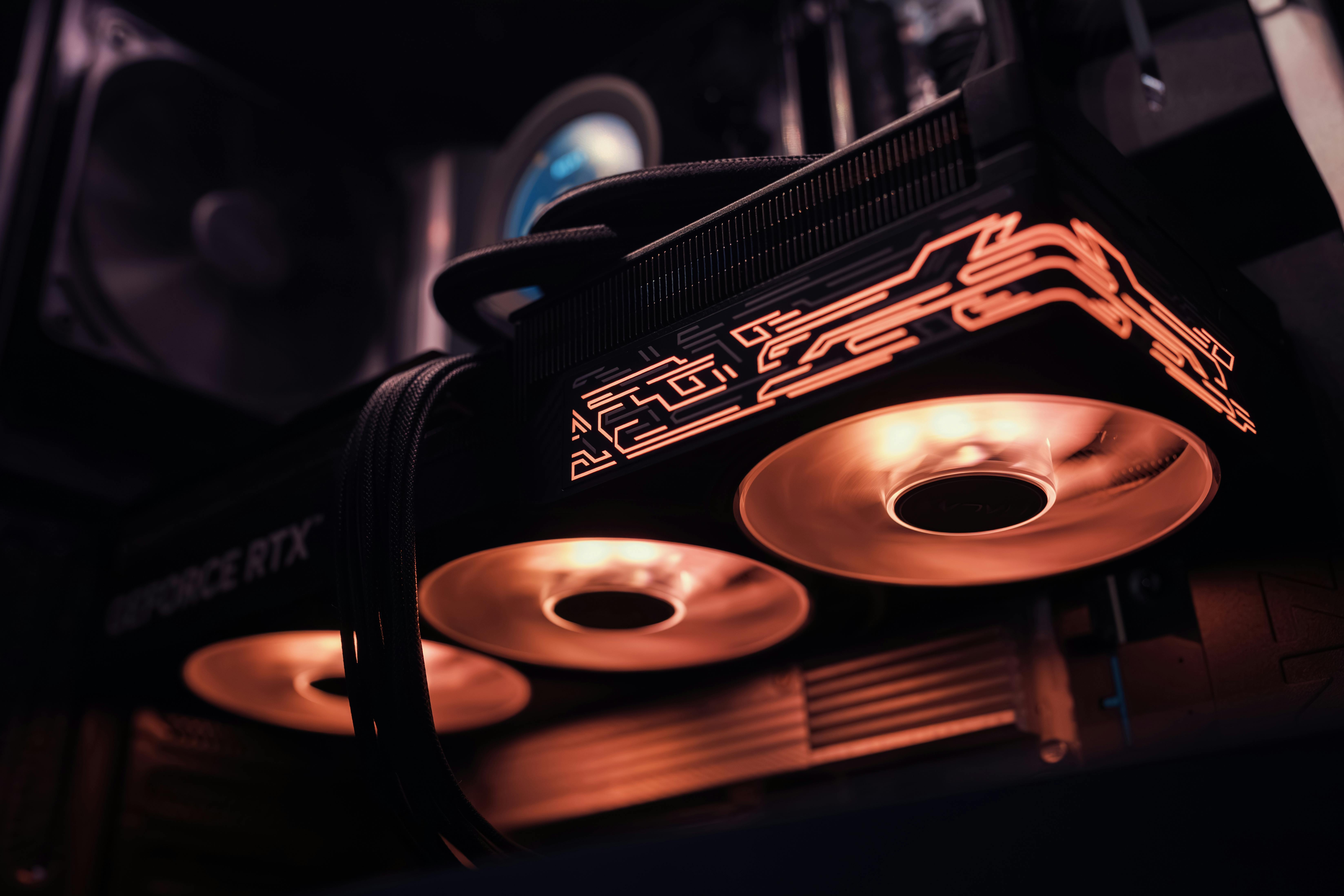
In 2026, AI upscaling and frame generation technologies like NVIDIA's DLSS 4.0, AMD's FSR 4.0, and Intel's XeSS 3.0 are no longer mere features but essential components for high-performance PC gaming. This comprehensive guide from searchgamex.com dives deep into the best gaming GPUs, comparing their AI-driven performance, value, and future-proofing capabilities to help you choose the ultimate gaming hardware upgrade for incredible frame rates and stunning visuals.
Introduction to the Topic
Welcome, gamers, to 2026! If you're still chasing native 4K at 120+ FPS without advanced assistance, you're likely leaving a significant portion of your GPU's potential on the table. The landscape of PC gaming has dramatically shifted, propelled by an exhilarating revolution in artificial intelligence. Today, AI upscaling and frame generation technologies are not just buzzwords; they are the bedrock of modern high-fidelity, high-refresh-rate gaming experiences. From the most demanding AAA blockbusters to competitive esports titles, these intelligent algorithms are redefining what’s possible with your gaming hardware.
At searchgamex.com, we understand that choosing the right gaming GPU in 2026 is more complex than ever. It's no longer just about raw shader count or clock speed; it's profoundly about the integrated AI accelerators and the sophistication of their proprietary upscaling and frame generation software. NVIDIA's DLSS 4.0, AMD's FSR 4.0, and Intel's XeSS 3.0 stand as the titans of this new era, each promising to deliver breathtaking visuals and unprecedented frame rates by intelligently reconstructing or generating pixels. But which one truly delivers the best bang for your buck, offers the superior image quality, and future-proofs your rig for the games of tomorrow? Let's dive deep into the AI-powered heart of 2026 gaming.
Backgrounds & Facts
The journey of AI in gaming graphics began subtly, primarily focused on denoising ray-traced images. However, with the advent of NVIDIA's DLSS (Deep Learning Super Sampling) in 2018, the true potential of AI-powered resolution scaling began to emerge. Fast forward to 2026, and we're looking at fourth-generation iterations and beyond, transforming rendering pipelines entirely.
At its core, AI upscaling works by rendering a game at a lower resolution (e.g., 1080p) and then using sophisticated AI models to intelligently reconstruct it to a higher target resolution (e.g., 4K). This process is significantly less computationally intensive than rendering natively at the higher resolution, leading to substantial performance gains. Frame generation, a more recent innovation, takes this a step further by inserting entirely new, AI-predicted frames between traditionally rendered frames, effectively doubling or more than doubling your perceived frame rate.
- NVIDIA DLSS 4.0: Leveraging dedicated Tensor Cores on GeForce RTX GPUs, DLSS remains the gold standard for many, particularly in image quality. By 2026, DLSS 4.0 has evolved to incorporate even more advanced temporal feedback and motion vectors, resulting in near-native image clarity and minimal artifacting. Its frame generation component, often known as DLSS Frame Generation, has also seen significant improvements in latency reduction and visual coherence, making high-refresh-rate 4K gaming a reality even on high-end cards.
- AMD FSR 4.0: AMD's FidelityFX Super Resolution took a different approach, being hardware-agnostic and utilizing conventional shader units. FSR 4.0 in 2026 boasts remarkable image quality improvements, closing the gap with hardware-accelerated solutions. Its frame generation technology, now fully integrated and optimized, offers competitive performance boosts across a wider range of GPUs, making it a compelling choice for those seeking broader compatibility.
- Intel XeSS 3.0: Intel's Xe Super Sampling, while newer to the scene, has rapidly matured. By 2026, XeSS 3.0 leverages the XMX engines (Matrix Extensions) on Intel Arc GPUs for hardware acceleration, offering a blend of performance and image quality that rivals its competitors, particularly in its target market segments. Its open-source nature and growing adoption make it a strong contender, especially as Intel's discrete GPU market share expands.
The key takeaway is that these technologies are no longer just about raw FPS numbers. They are about delivering a smoother, more immersive visual experience without compromising fidelity. Game developers are increasingly building their titles with these technologies in mind, making them integral to the modern gaming pipeline.
Expert Opinion / Analysis
The "AI wars" in gaming GPUs have escalated dramatically by 2026, with each manufacturer vying for supremacy in performance, image quality, and developer adoption. The implications for gamers are profound, shifting the focus from simply buying the most powerful GPU to selecting one with the most effective and widely supported AI acceleration.
"We're witnessing a paradigm shift in how games are rendered," explains Dr. Anya Sharma, Lead Graphics Architect at Quantum Dynamics Studios, a studio renowned for pushing visual boundaries. "Five years ago, we were optimizing for raw pixel output. Today, we're optimizing for intelligent pixel synthesis. Technologies like DLSS 4.0, FSR 4.0, and XeSS 3.0 allow us to create incredibly detailed, ray-traced worlds that simply wouldn't be playable at high frame rates without them. The algorithms are so sophisticated now that, in many cases, the AI-upscaled image is perceptually superior to a native image rendered with less anti-aliasing or graphical settings."
Dr. Sharma further elaborates, "NVIDIA's advantage often lies in its dedicated hardware. Tensor Cores provide a significant, consistent performance uplift that is hard to match with general-purpose shaders alone, especially for complex deep learning models. However, AMD's FSR has democratized the technology, pushing adoption across a wider user base, which in turn encourages developers to integrate it. Intel, with XeSS, is rapidly carving out its niche, particularly as their hardware matures and becomes more prevalent in the mid-range and high-end segments."
The competitive landscape also influences game development. Studios are now making strategic decisions based on which AI upscaling tech they prioritize for optimization. While multi-tech support is common, there can be subtle differences in implementation and optimization quality. Gamers with purchasing intent must consider not only the raw power of a GPU but also its ecosystem – the robustness of its AI software, driver support, and the breadth of game titles that fully leverage its capabilities. The future isn't just about rendering more pixels; it's about rendering smarter pixels.
💰 Best Options in Comparison (VERY IMPORTANT)
Choosing the right gaming GPU in 2026 means carefully evaluating its native performance alongside its AI upscaling and frame generation prowess. Here, we present the top contenders across different price points, highlighting their strengths in the AI-accelerated gaming landscape.
- NVIDIA GeForce RTX 6080 Ti: The Uncompromising AI Powerhouse
The flagship from NVIDIA, the RTX 6080 Ti (based on the hypothetical Ada Lovelace Next Gen architecture), represents the pinnacle of AI-accelerated gaming. Equipped with a new generation of Tensor Cores and an optimized DLSS 4.0 engine, this card delivers unparalleled performance in 4K with ray tracing enabled. DLSS 4.0 Frame Generation is incredibly refined, offering buttery-smooth frame rates even in the most demanding titles. If budget is no object and you demand the absolute best in visual fidelity and FPS, especially with NVIDIA's proprietary technologies, this is your champion. Its robust 28GB GDDR7 VRAM ensures future titles are handled with ease. - AMD Radeon RX 9900 XT: The Versatile AI Performer
AMD's Radeon RX 9900 XT, built on the cutting-edge RDNA 5 architecture, is a formidable competitor. With FSR 4.0, AMD has achieved significant strides in image quality, often matching or closely approaching DLSS in many scenarios, while maintaining its open-source advantage. The RX 9900 XT offers exceptional native rasterization performance, and when coupled with FSR 4.0's frame generation, it delivers a high-end 4K gaming experience that provides incredible value. Its 24GB GDDR7 VRAM is ample for any demanding workload. For gamers seeking top-tier performance without being locked into a specific ecosystem, the RX 9900 XT is a compelling choice. - Intel Arc A990: The Smart Value AI Contender
Intel's Arc A990 (utilizing the Xe-HPG++ architecture) represents a significant leap for Team Blue. Positioned in the upper-mid range, the A990 leverages XeSS 3.0 with its dedicated XMX engines to deliver impressive performance uplifts. While its native rasterization might not always match the top-tier cards from NVIDIA and AMD, XeSS 3.0 closes the gap considerably, making 1440p high-refresh-rate gaming and even entry-level 4K gaming viable. Intel's continuous driver improvements and commitment to the gaming space make the Arc A990 an increasingly attractive option for value-conscious gamers looking to experience the benefits of AI upscaling without breaking the bank. It offers a solid 16GB GDDR7 VRAM, which is excellent for its price segment.
To help you make an informed decision, here's a detailed comparison:
| Feature / GPU | NVIDIA GeForce RTX 6080 Ti | AMD Radeon RX 9900 XT | Intel Arc A990 |
|---|---|---|---|
| AI Upscaling Tech | DLSS 4.0 (Hardware-accelerated) | FSR 4.0 (Shader-based, highly optimized) | XeSS 3.0 (XMX-accelerated) |
| Architecture (Hypothetical) | Ada Lovelace Next Gen | RDNA 5 | Xe-HPG++ |
| VRAM (GDDR7) | 28GB | 24GB | 16GB |
| Native 4K Performance | Excellent | Excellent | Good |
| AI-Boosted 4K Performance | Outstanding (often 100+ FPS) | Very Good (strong competitor) | Good (viable for 60 FPS+) |
| Ray Tracing Performance | Class Leading | Strong | Improved (competitive mid-range) |
| Compatibility | NVIDIA RTX GPUs only | All modern GPUs (cross-vendor) | Intel Arc, some others (growing) |
| Typical Price (USD - 2026 Est.) | $1299 - $1499 | $1099 - $1299 | $599 - $699 |
| Target User | Enthusiast seeking max FPS/Fidelity, NVIDIA ecosystem | High-end, value-conscious, broader compatibility | Mid-range, early adopter, strong price/performance |
Outlook & Trends
The trajectory of AI in gaming graphics points towards even deeper integration and more transformative capabilities. By 2026 and beyond, we anticipate several key trends:
- Universal Standards & APIs: While proprietary solutions currently dominate, there's a growing industry push for more unified APIs or standards for frame generation and upscaling. This would simplify development and ensure broader support across all hardware, potentially leading to an "AI API" that game engines universally adopt.
- Hardware-Agnostic AI: While NVIDIA benefits from dedicated hardware, the trend suggests that even shader-based solutions will continue to improve dramatically, leveraging increasingly powerful general-purpose compute units on GPUs. This could further blur the lines between proprietary and open solutions.
- AI Beyond Graphics: The influence of AI won't stop at rendering. Expect to see AI play a more significant role in dynamic game content generation, realistic NPC behavior, adaptive difficulty, and even personalized gaming experiences. GPUs, with their massive parallel processing capabilities, will be central to these advancements.
- Cloud Gaming Synergy: AI upscaling is a game-changer for cloud gaming services. By rendering at lower resolutions on server farms and upscaling to the user's screen, cloud platforms can deliver higher-quality, lower-latency streams to a wider range of devices, making services like GeForce NOW or Xbox Cloud Gaming even more compelling.
- Real-time Ray Tracing Evolution: With AI upscaling handling the performance overhead, game developers will be emboldened to implement even more complex and realistic ray tracing effects, pushing visual fidelity to photorealistic levels without crippling frame rates.
- New Competitors & Innovation: The success of AI in gaming GPUs could attract new players to the discrete graphics card market, fostering even greater innovation and competition, ultimately benefiting the consumer with more choices and better technology.
The future of gaming is undeniably intertwined with artificial intelligence, and the GPUs of 2026 are just the beginning of this exciting journey.
Conclusion
In 2026, the question is no longer "Do I need AI upscaling?" but "Which AI upscaling technology best suits my gaming needs?" The days of purely brute-force rendering are behind us. NVIDIA's DLSS 4.0, AMD's FSR 4.0, and Intel's XeSS 3.0 have irrevocably transformed the gaming landscape, offering unprecedented performance gains and visual quality enhancements that are essential for experiencing modern titles at their best.
For the ultimate, no-compromise 4K ray-tracing experience, the NVIDIA GeForce RTX 6080 Ti, with its superior DLSS 4.0 implementation, remains the top-tier choice. If you're looking for incredible high-end performance with broader compatibility and excellent value, the AMD Radeon RX 9900 XT and its robust FSR 4.0 deliver a compelling package. And for gamers seeking a smart, powerful mid-range option that punches above its weight with XeSS 3.0, the Intel Arc A990 is a strong contender that promises great value and future potential.
Before your next gaming hardware upgrade, consider your budget, your preferred resolution, and the games you play most. Look for titles that fully support these AI technologies, as that's where you'll unlock the true potential of your new GPU. Embrace the AI revolution; it's the key to unlocking maximum FPS and breathtaking visuals in 2026 and for years to come. Happy gaming!