
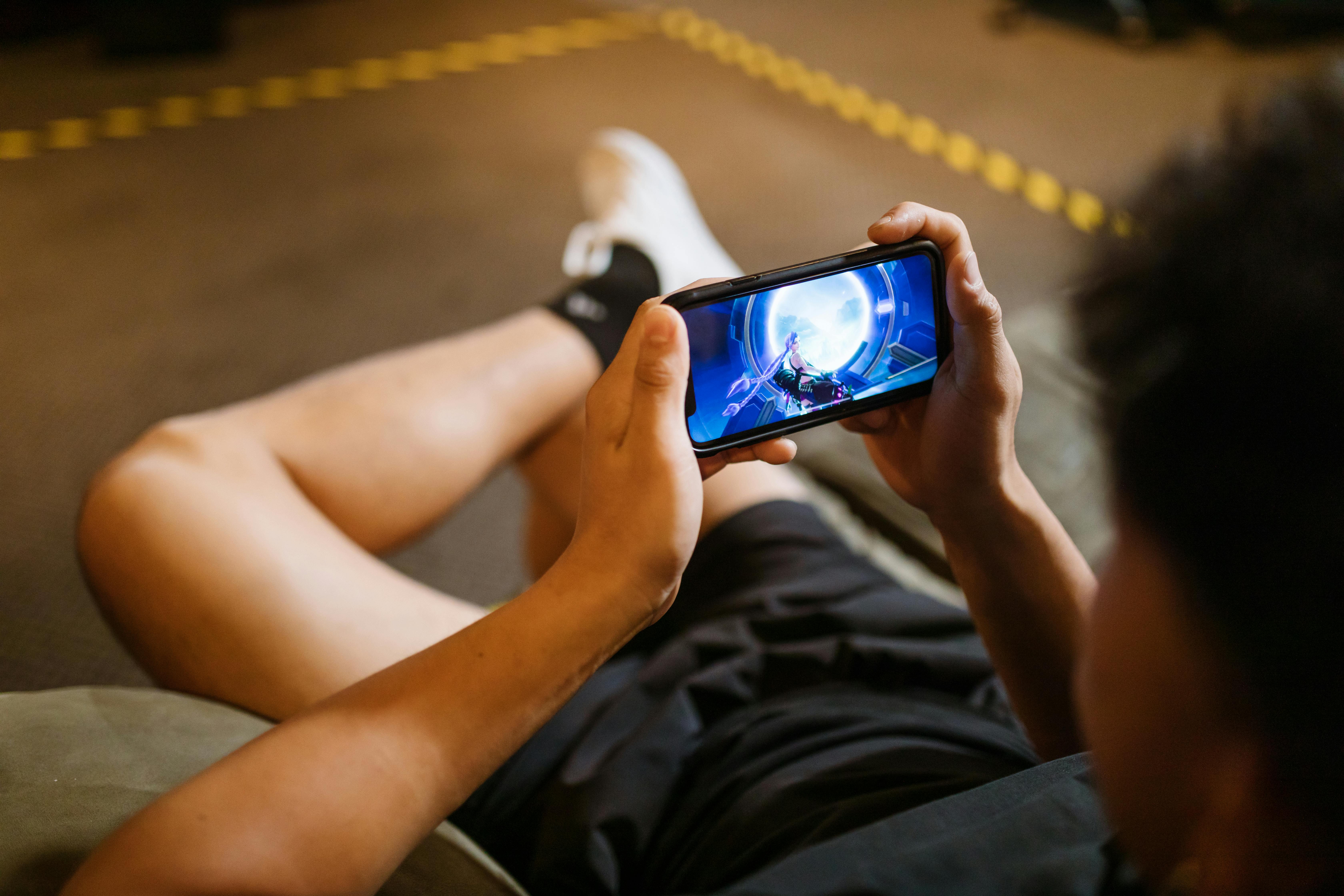
Designing for a touchscreen is not a matter of drawing buttons on glass. Two physical properties of the surface change what inputs are reliable, and games are built around them.
There is no way to find a control by feel
A physical controller lets a player locate every input without looking, because the shapes and edges are distinguishable under the fingers.
A screen offers no such landmarks, so a player must look at where they are pressing, taking attention away from the action they are responding to.
Games compensate with generous target areas, controls anchored to the point where a finger lands rather than to fixed positions, and gestures that work anywhere on screen.
Hands cover the display they are operating
Thumbs occupy the lower corners, and fingers wrap around the edges. A meaningful portion of the screen is obscured whenever the player is doing anything.
Important information is therefore placed centrally or along the top, and games avoid putting a critical readout where a control sits.
This also constrains camera framing, since a subject positioned low in the frame can be hidden by the hand that is moving it.
Input precision is lower and noisier
A finger contacts a broad area rather than a point, and the system infers a single position from it. Small targets are unreliable in a way a cursor is not.
Analogue control is also weaker, because a virtual stick has no centring force and no physical limit, so the player cannot feel how far they have pushed.
Games respond by simplifying the input space: tap and hold rather than graded pressure, automatic aiming assistance, and movement that resolves to a small number of directions.
Session context is part of the design
Mobile play happens in short intervals, often interrupted, frequently one-handed and sometimes without sound. Each of these removes an assumption a console game can make.
Designs adapt by making progress saveable at any moment, conveying essential information visually rather than through audio, and avoiding sequences that require sustained precision.
This is why direct ports of console games perform poorly even when the hardware is capable. The controls are only part of the mismatch.
Controller support does not resolve the tension
Attaching a physical controller removes the input limitations, and a minority of players do so. Designing around it is a different matter.
A game tuned for a controller becomes harder to play on the screen, which is how the overwhelming majority of its audience will play it.
Most studios therefore treat controller support as an accommodation layered on a touch-first design, rather than as a second design the game is equally built for.